
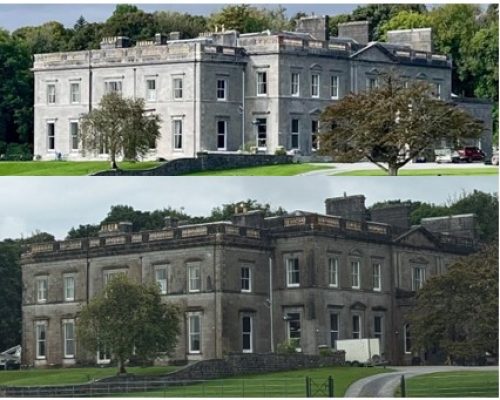
Exterior treatment of historic buildings often focuses on the removal of visible staining. However, the chemistry involved in that process can have lasting implications for the building fabric.
Stone, lime render and historic mortars are sensitive materials. Their long-term behaviour is influenced not only by environmental exposure but also by the chemicals applied to their surfaces.
For this reason, transparency regarding the products used during exterior treatment is essential.
Understanding what is being applied
A wide variety of chemical products are marketed for exterior cleaning. Some are specifically designed to target biological growth such as algae and fungi. Others are general-purpose cleaning agents that may produce rapid visual change but whose compatibility with building materials is less certain.
Highly caustic chemicals, particularly chlorine-based products, can alter the surface characteristics of stone and render. In some cases, the removal of natural patina or the etching of mineral surfaces can increase porosity and leave materials more vulnerable to future colonisation.
Historic buildings require methods that respect both the material and the long-term performance of the structure.
The importance of Safety Data Sheets
One of the simplest ways to understand what product is being used during exterior treatment is to review the Safety Data Sheet (SDS).
This document provides information on:
- Chemical composition
- Environmental considerations
- Handling procedures
- Potential hazards
Requesting this document should be considered normal professional practice when any chemical product is applied to a historic structure.
Further guidance on chemical safety and classification can be found through the European Chemicals Agency (ECHA):
Biological treatment approaches
Modern exterior treatment increasingly focuses on targeting the biological organisms responsible for staining.
Algae forms the base layer of the biomass ecosystem found on buildings. Once algae colonises a surface, fungi, lichens and moss can follow. Removing or neutralising the algae interrupts this process and allows natural weathering to gradually restore the appearance of the surface.
Research has shown that microorganisms interacting with stone can influence mineral stability and surface behaviour over time. Definitive Guide To Biomass Gro…
Understanding these biological interactions is essential when selecting appropriate treatment methods.
A question of stewardship
Historic buildings represent cultural, architectural and social heritage. Any intervention must therefore be approached with a clear understanding of both the materials involved and the long-term implications of the chosen method.
Exterior treatment should always prioritise the preservation of the building fabric over short-term visual change.
For examples of how careful exterior treatment can restore the natural appearance of historic stone without altering the surface, you can view a selection of recent conservation projects in our project gallery.
Click here for the earlier discussion on cleaning damage to historic buildings.